Wingsuit Proximity Flying in 2026: Terrain-Following Lines, Flocking, and the Margin for Error
A wingsuit pilot skims a Norwegian ridge at 200 km/h with metres to spare — here's the suit tech, terrain-following lines, and altitude math that separate a clean pass from a fatal one.
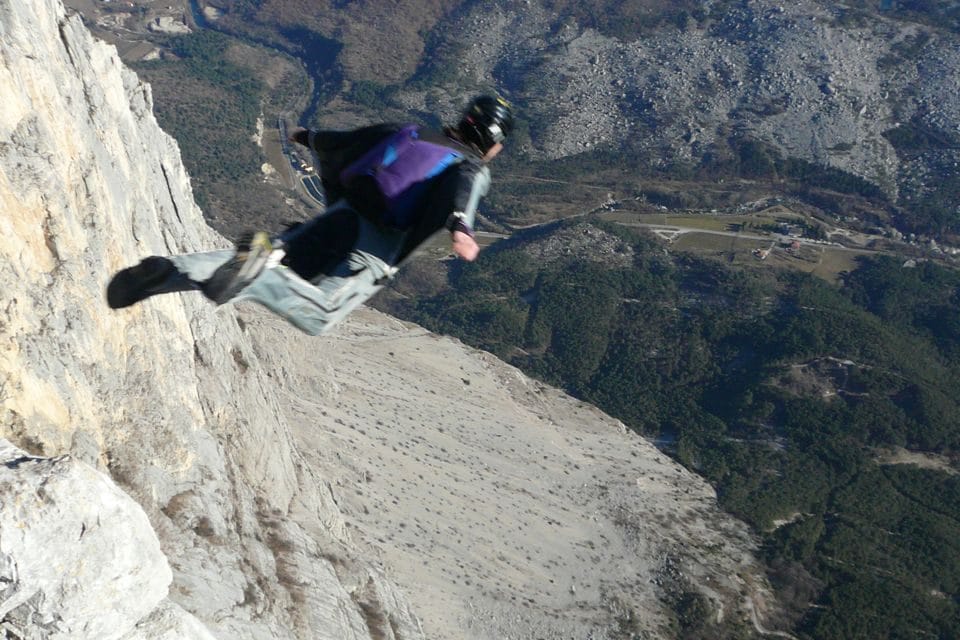
A wingsuit pilot flying twenty metres above a Norwegian valley floor is moving somewhere close to 200 km/h horizontally while sinking at roughly 15 metres per second — numbers that leave almost no room to correct if a gust pushes the suit six metres off its intended line. That is proximity flying: not just falling in a suit, but tracing a chosen path along terrain close enough that spectators, and the pilot, can hear wind moving through pine branches during the pass. In 2026 the discipline is smaller and more scrutinised than it was a decade ago, but it hasn't slowed down. The top pilots are simply flying tighter lines with better data behind them and less patience for public error.
From Rag Wings to Rigid-Cell Suits — the Current Generation
Wingsuit design has moved a long way from the loose fabric "flying squirrel" prototypes of the early 2000s. Current-generation suits like Squirrel's Wasp4 and Union, TonySuit's Apache and Stealth-X, and Phoenix-Fly's Vampire 5 use pre-tensioned ram-air cells along the arm wings and leg wing, which hold their airfoil shape under load instead of collapsing into a rag of nylon the moment the pilot rolls or banks hard. That structural rigidity is what lets a pilot carve a turn at proximity altitude without the wing stalling mid-manoeuvre. Glide ratios on a well-flown modern suit run 2.5:1 to 3:1 — for every metre lost in altitude, the pilot covers two and a half to three metres of forward distance — and the best proximity pilots fly closer to the top of that range because clean airflow over a rigid wing costs less drag than a soft one. If you're picking a first proximity suit in 2026, go with forgiving stall behaviour over raw top speed, full stop — the Wasp4 and the Stealth-X are the two suits worth learning on, and the reason has nothing to do with how fast either one goes.
Terrain-Following Lines — How a "Line" Actually Gets Built
A proximity line isn't improvised. Pilots scout a wall or ridge with drone footage first, mapping rock features, tree lines, and known wind patterns across multiple visits before committing to a flight plan. GPS flight-tracking units — FlySight is the standard piece of kit — log altitude, groundspeed, and vertical speed on every jump, and pilots review that data afterward the way a race driver studies telemetry, trimming a line metre by metre across dozens of flights at increasingly tight clearance.
A line is rehearsed at safe altitude roughly a hundred times before it's ever flown close to terrain.
That rehearsal happens over open valley floor or flat ground first, well above any obstacle, so the pilot's muscle memory for the exact bank angle and pitch input is already automatic before terrain enters the picture. Only after a pilot can repeat the same track within a metre or two, jump after jump, does the group start moving the flight path closer to rock — and even then, the first pass at a new site is flown wide, with clearance measured in tens of metres rather than the single digits seen in finished footage.
Flocking — Formation Flying With Real Consequences
Flying two or more wingsuits together, known as flocking, multiplies the coordination problem because each pilot's wake disturbs the air the next pilot flies through. A trailing pilot who drifts into the "burble" behind a lead suit can lose lift instantly, and at proximity altitude that loss of lift has nowhere to recover into. Groups solve this with strict formation discipline: fixed spacing (typically five to ten metres laterally, staggered in depth), a single lead pilot who chooses the line, and hand signals or pre-briefed calls rather than radio chatter mid-flight, since a pilot's hands are already occupied flying the suit. Red Bull's Aces wingsuit race format keeps flocks small — pairs or trios through a gate course — for exactly this reason; large-group flocking, the kind that produces the eight- and nine-person formations seen in skydiving world-record attempts, is reserved almost entirely for open-sky work well above any terrain, not for proximity lines.
The Margin-for-Error Math
The number that actually governs proximity flying isn't top speed, it's decision altitude — the height above the ground at which a pilot must abandon the wingsuit track, flare into a stable body position, and deploy a parachute. For wingsuit BASE jumps that's commonly around 150 metres above the landing area, sometimes lower on experienced pilots flying known exits, and it has to account for both the altitude lost during the flare itself and the altitude the canopy needs to open and become steerable. Closest-approach clearance on a well-flown proximity line runs anywhere from three to ten metres past a rock feature at 150–200 km/h groundspeed — distances that look enormous on a GoPro's wide-angle lens and leave almost nothing in reality. Tighter clearance photographs better, and that tension between what makes compelling footage and what keeps a pilot alive is one the community argues about constantly rather than one it has resolved; several well-known pilots have said publicly that they fly wider lines than their sponsors or their own highlight reels would suggest, precisely because the margin that looks dramatic on camera is the same margin that has killed experienced flyers, including some who were flying lines they'd successfully completed dozens of times before.
Getting There — Training Progression From Skydiving and BASE
Nobody starts in a wingsuit at a cliff edge. The International Skydiving Commission's first-flight-course structure requires a minimum jump count before a candidate can even take a beginner wingsuit course — most drop zones set that bar at 200 skydives — and pilots then progress through three suit categories, Wingsuit 1 through Wingsuit 3, gaining wing surface area and speed only after logging set numbers of jumps in the previous category without incident. BASE jumping runs its own separate progression on top of that: the informal but widely respected standard in the community holds that a pilot should have at least 250 BASE jumps on a standard canopy, across multiple exit types, before adding a wingsuit to a BASE jump at all. Skip that progression and the failure mode isn't a bad landing — it's a pilot who has never had to make a split-second body-position correction under load, doing it for the first time next to a wall.
Gear Beyond the Suit — Helmets, Audibles, and the AAD Question
A full-face helmet is close to universal now, both for impact protection and because it holds the action camera mount that every serious proximity pilot flies with; Cookie's G4 and Bern's Watts are two of the models that show up most often in the discipline. Audible altimeters — small devices worn inside the helmet that beep at preset altitudes — matter more here than in almost any other extreme sport, because a pilot tracking terrain at 200 km/h cannot spare the half-second it takes to glance at a wrist-mounted instrument. L&B's Optima and Alti-2's Solo2 are the two units most proximity pilots trust, and if your budget forces a choice between a marginally faster suit and a proper audible, buy the audible — you can fly a slower wing safely, but you can't fly a fast one blind. Automatic activation devices, the units that fire a reserve parachute if a skydiver fails to deploy by a set altitude, are standard equipment on wingsuit jumps from an aircraft — Airtec's Cypres2 and Vigil's Vigil2 are the common choices there. They are almost never used on wingsuit BASE jumps, though, because BASE exit altitudes are frequently too low for an AAD's activation logic to fire in time, and the devices aren't calibrated for the steep, fast trajectories a wingsuit BASE jump produces. That gap is one the wingsuit BASE community has simply learned to fly around rather than solve.
Risk Culture in 2026
The sport's internal accountability has tightened noticeably over the past several years. Established groups now share incident reports openly rather than treating fatalities as private tragedies to be quietly absorbed, and most serious proximity crews will scrub a planned line entirely if wind readings at the exit point don't match forecast within a tight tolerance — not "probably fine," a hard no. Drone verification of a line immediately before flying it, checking for anything that's changed since the last scouting pass — a fallen branch, a patch of wet rock, birds nesting in a new spot — has become close to standard practice at the sites with the most jump traffic. None of that has made proximity wingsuit flying safe in any conventional sense, and nobody serious in the community claims otherwise. What it has done is shrink the number of deaths attributable to avoidable mistakes, leaving the risk that remains concentrated on the part of the sport that was always going to be dangerous no matter how much preparation goes into it: flying a rigid-cell wing within single-digit metres of a rock face at highway speed, on a line that has to be flown correctly the first time it's flown for real.