Teahupo'o 2026: Inside the World's Heaviest Wave and the Reef That Makes It Deadly
The 2026 Outerknown Tahiti Pro returns to Teahupo'o, the reef break behind five deaths since the 2000s, as the World Surf League's leaders chase results on the heaviest wave in competitive surfing.
The Reef That Rewrites the Rules of Surfing
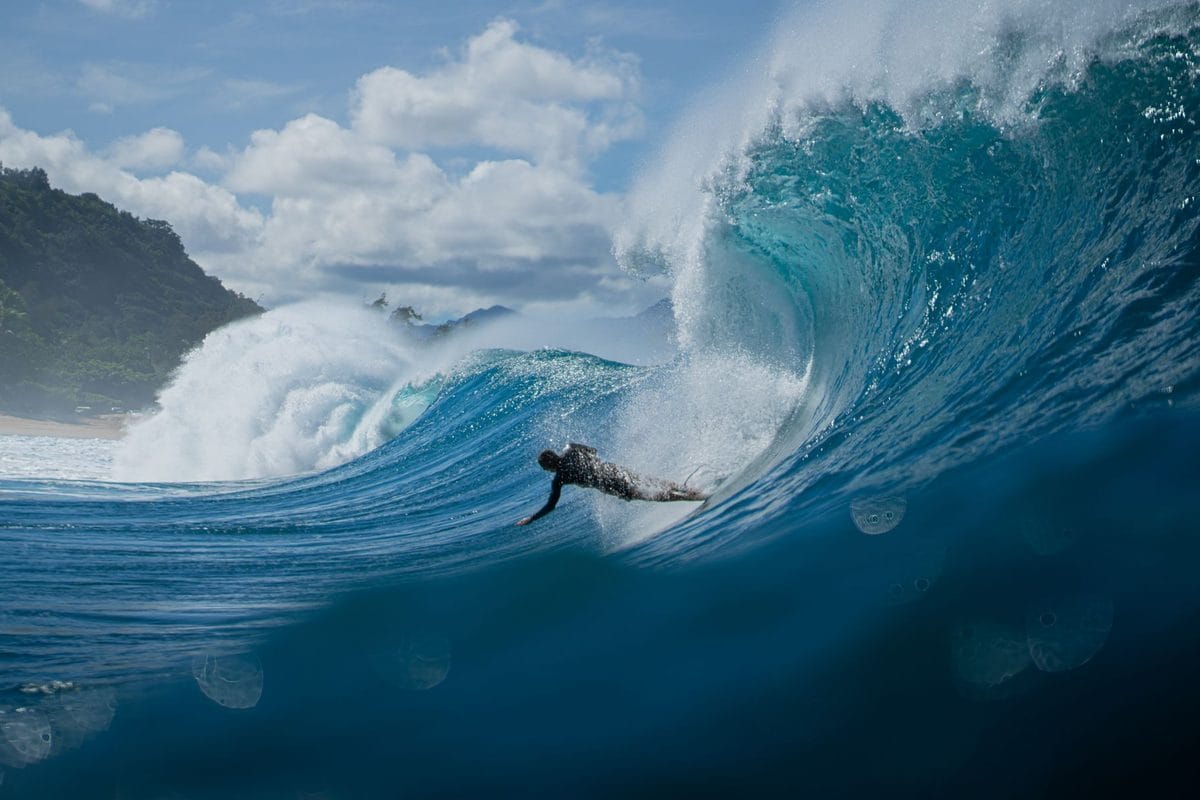
Three miles off the south coast of Tahiti, the Pacific floor sits roughly 5,000 feet down. Paddle another two and a half miles toward shore and that same floor has climbed to around 1,000 feet, then keeps rising until it slams into a coral shelf barely a few feet under the surface. Every southwest swell that rolls in from the Southern Ocean carries its full open-ocean energy almost all the way to that shelf before the seabed finally interrupts it — and when it does, the water doesn't just break, it detonates. The reef at Teahupo'o pulls water off itself as the wave stands up, which means the surfer dropping in is briefly riding below the level of the surrounding ocean, staring down a wall of water with the reef close enough to touch. It's the same basic mechanics that make Pipeline on Oahu's North Shore infamous, except the shelf at Teahupo'o sits shallower and the takeoff zone gives a falling surfer far less room to bail before the lip lands. Surfers who've ridden both waves tend to agree on one thing: Pipeline can knock you out, but Teahupo'o can cut you open on the way down.
That geography is why the Outerknown Tahiti Pro, round seven of the 2026 World Surf League Championship Tour, treats an August date at Teahupo'o as one of the season's genuine tests rather than a routine stop. The event window opened on August 8 and runs through August 18, and it landed at the "End of the Road" — the literal end of the coastal highway on Tahiti's southwest side — after a month-long layoff since the Rio Pro, where Yago Dora and Sawyer Lindblad took the wins. Nobody on tour needed a reminder of what waits in the Hava'e Pass, but the swell that showed up for the season opener earlier this year did the reminding anyway: 20-foot barrels, heavy wipeouts, and drone footage that made even veteran watermen stop scrolling.
A Wave With a Body Count
Five surfers have died at Teahupo'o since the 2000s.
The seabed there is living coral, not sand, and it shreds skin, bone, and boards with equal indifference — which is a large part of why so many competitors now wear impact vests and helmets that would have looked out of place on tour a decade ago.
Mike Stewart, one of the first watermen to ever ride the wave and still one of its most respected voices, has talked openly about what separates a survivable wipeout from a bad one: don't let the wave pitch you toward the trench, the shallowest section of reef beneath the barrel, and know exactly where you are on the wave face before you commit to a fall. Local surfers spend years reading the reef before they ever paddle for a set wave there, learning which pass to take on the way in and which channel gets them out before the next set arrives. If you've never surfed a shallow reef break before, Teahupo'o is not the place to start — every guide, every local, and every safety briefing on that boat says the same thing, and the five deaths back it up.
Ahead of the wave's Olympic debut at Paris 2024, two-time Olympic gold medalist Carissa Moore put the core danger in blunt terms: "The takeoff point is super steep and critical, so you have to have the skill and reaction time to time it right... and if you don't, there can be consequences." Even with that warning on record, this year's season-opening swell — full 20-foot faces, sets that most recreational surfers wouldn't paddle toward — saw every rider in the water walk away, Tahitian local Matahi Drollet among them, looking as comfortable in the lineup as anyone alive.
The Reef Locals Fought to Protect
The same coral shelf that makes Teahupo'o the heaviest wave on tour is also a living reef system that Tahitians spent years defending in court and in the streets. When Paris 2024 organizers proposed replacing the wave's aging wooden judging tower with a new aluminum structure built directly on the reef, Matahi Drollet — the same local surfer now competing at this year's Tahiti Pro — became one of the loudest voices against it, warning on social media that construction risked damaging "the reef and the whole ecosystem of the lagoon in front of the wave… and in the worst case scenario, the wave of Teahupo'o also." A petition against the tower gathered close to 100,000 signatures, and a barge involved in construction ran aground on the reef during high tide, handing opponents exactly the kind of evidence they didn't want to be right about.
Organizers eventually shrank the design down to match the old tower's footprint, cut its weight from 14 tonnes to nine, and stripped out the wastewater and drinking-water connections that had triggered the loudest objections. Marine scientists who surveyed the build site beforehand counted more than 1,000 coral colonies across 20 species — proof, whichever side of the fight you were on, that the reef surfers ride over is not some dead slab of rock but a functioning ecosystem that happens to also produce the best barrels in the sport. The tower is still standing today, reassembled for every major event including this year's Outerknown Tahiti Pro, a permanent reminder that the wave and the reef beneath it are the same fragile thing.
Who's Paddling Out at the End of the Road
Leonardo Fioravanti arrived in Tahiti wearing the Yellow Jersey for the first time in his career, the result of a mid-season run strong enough to put him atop the men's rankings heading into round seven. On the women's side, Gabriela Bryan holds the equivalent lead, and both surfers now have to defend that position on a wave that punishes hesitation more than almost anywhere else on tour.
- Eimeo Czermak and Kelia Gallina won their wildcard spots by surfing pumping Teahupo'o in the trials — not a forgiving stage for a wildcard debut.
- Matahi Drollet, the Tahitian local who has built his reputation almost entirely on this one wave, is exactly the kind of surfer visiting pros watch on the boat before they paddle out themselves.
- Fioravanti and Bryan both need results here to protect their rankings, and neither has the luxury of sitting out a heat to wait for better conditions.
None of that guarantees anything once the horn sounds. A Yellow Jersey means nothing to a wave that doesn't care who's wearing it, and Teahupo'o has ended plenty of good seasons in a single heat.
The Forecast Nobody Wanted to Ignore
Surfline's forecast issued August 4 flagged an active storm track sitting almost directly on French Polynesia's doorstep, with peak seas in the open ocean reaching 30 to 35 feet within roughly 1,200 miles of Teahupo'o. Swellnet's competing read for the event's Training Day and Day One pointed to 8- to 10-foot Hawaiian-scale sets holding through Saturday, with south-east Maraamu trade winds — favorable early, then turning tricky as the swell peaked. By the time competition actually got underway, BeachGrit was describing conditions during Round 2 Heat 5 as "inhumane," with wave faces in the 15- to 18-foot range and a follow-up swell already building from a storm system far south in the Tasman Sea. WSL's water safety crew — jet ski drivers and rescue sleds stationed in the channel for every heat — becomes the most watched team on the water once swell hits that size, since a hesitant pickup can cost a surfer critical seconds inside the impact zone. None of the surfers in the draw treat that safety net as a reason to take the wave lightly; if anything, the presence of jet skis on standby is the clearest signal of how seriously the tour takes conditions like these.
Big and clean are not the same thing at Teahupo'o, and this year's opening days made that distinction obvious. Large swell paired with unfavorable wind can turn a rideable Teahupo'o into a closed-out, chaotic mess that judges struggle to score fairly — size alone doesn't guarantee the kind of barrels this wave is famous for, and a shifting wind window can strand a surfer mid-heat with nothing worth catching. Anyone judging this event purely by wave height is missing the point: the real skill test at Teahupo'o is knowing which two or three waves in a session are actually worth taking, and sitting out the rest. That tension between the forecast everyone wanted and the forecast that actually showed up is why event organizers build multi-day waiting periods into every Teahupo'o stop rather than locking in a single fixed date.
Whatever happens across the rest of the waiting period, the Outerknown Tahiti Pro will be decided the way most Teahupo'o events are decided — on one or two genuinely good days buried inside a ten-day window, with the rest spent watching the horizon and hoping the wind holds. That's the wave. It always has been.