Downhill Mountain Biking in 2026: World Cup Line Choice, Suspension Setup, and Why the Best Riders Brake Less Than You Think
Elite downhill racers walk a track for hours before riding it once, and the fastest among them brake far less than you'd expect. Here's how World Cup-level line choice, suspension setup, and braking technique actually work, plus what it costs to start properly in the UK.
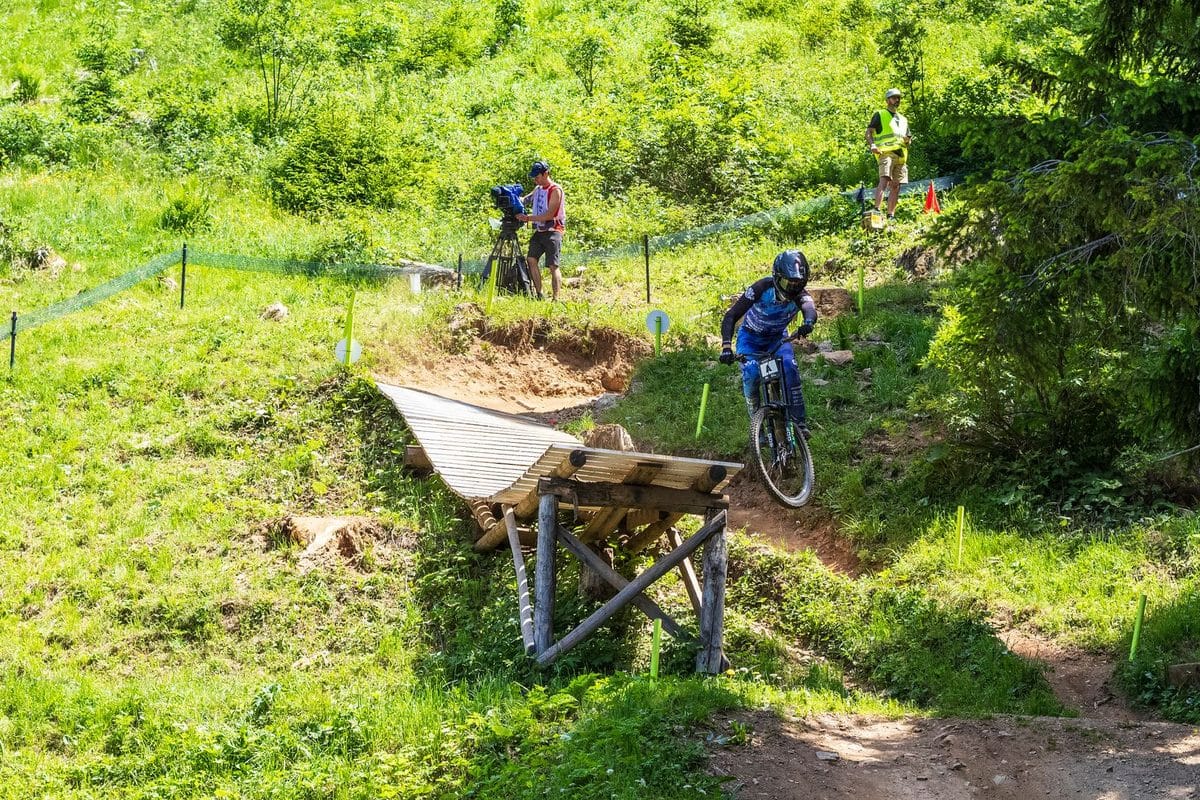
The start gate at Fort William drops into fog more often than not, and on a wet Thursday practice run the fastest riders on the hill aren't the ones grabbing a fistful of brake before every root. They're the ones barely touching the levers at all. Watch a World Cup downhill run in slow motion and the real surprise isn't how hard the top ten brake — it's how rarely they do it. Speed retention, not late braking, is what separates a top-twenty finish from a top-five one, and that single idea reshapes almost everything else about how a serious rider should set up a bike, choose a line, and train for the discipline.
Reading the Line Before Practice Even Starts
Elite downhill riders spend more time walking a track than riding it, and that's the first thing that separates a fast amateur from a genuine racer. A three-minute World Cup run at Leogang or Val di Sole gets six to eight hours of walking across two or three practice days, broken into short sections studied from every angle before a wheel ever touches them. Riders who skip that groundwork are the ones adjusting their line mid-race instead of committing to it, and that hesitation costs far more time than any single mistake ever does. The work isn't memorising every rock on the hill — it's identifying the two or three sections where a wrong choice costs half a second, then building the rest of the run around protecting speed into those points. Rock gardens get most of the attention from spectators, but the real time is often lost or won in the transitions between features, the flat, unremarkable ten metres where a rider either carries speed off the last berm or scrubs it fighting for grip. Pin the entry to a rock section too hot and the natural response is to brake through it, which kills exactly the momentum built on the straight before. Line choice, done properly, is really speed management dressed up as route-finding: the best line isn't the shortest one, it's the one that carries the most speed through the next three features, not just the one directly ahead.
That's a genuinely different skill from enduro racing, where a single wrong pedal stroke rarely ends a stage outright. In downhill, one bad line choice through Fort William's rock garden section can end a run in the first thirty seconds, and there's no clawing back the two minutes that follow.
Suspension Setup: Why More Travel Isn't the Answer
Most amateur downhill riders run too much travel and too little sag, and both mistakes come from the same instinct: more support feels safer. It isn't. Start with sag, not clicks — 30% of travel at the rear and 20–25% at the front is the standard starting point for a 200mm-travel race bike, whether that's a RockShox BoXXer, a Fox 40, or an EXT Vaia dual-crown fork. Set the sag first, ride the same three sections of track, then touch compression damping. Riders who dial in high-speed compression before the sag is correct are chasing a moving target — every click they add is compensating for a spring rate that was wrong to begin with.
Where amateurs really lose time is at the extremes: too soft and the bike wallows through rock gardens, using all its travel in the first hit and bottoming out on the second; too firm and it skips across chatter instead of tracking it, which feels fast and controlled but actually costs grip exactly where grip matters most. A 203mm-travel fork isn't inherently better than a 180mm one — it's better for Fort William's rock gardens and Val di Sole's rough, root-strewn straights, and it's genuinely overkill for a smoother, pedally track like Pal Arinsal, where a shorter-travel enduro-adjacent bike will out-corner a full race sled all day. Buy the bike that matches the tracks you actually ride, not the one that wins World Cups on television.
Braking Less, Not Later
Here's the uncomfortable part for most club-level riders: braking is a skill you're using too often, not too late.
The instinct under pressure is to brake into the corner, release, then pedal or coast out the other side. Good downhill riders do the opposite — they get their braking done early and hard, in a straight line, before the corner starts, then release the brakes entirely and let the tyres do the cornering work unloaded. Trail braking, dragging the rear brake gently through the apex, has its place on loose, off-camber corners where a fully released bike wants to wash out from underneath you. But used as a default habit rather than a specific tool, it bleeds speed exactly where a rider needs grip the most, and it's the single biggest gap between a fast amateur and a genuine racer. Shimano Saint and SRAM Maven both deliver more raw stopping power than most riders will ever need on a bike park lap; the limiting factor was never the brake, it's knowing when not to use it.
The Injury Ledger
Downhill racing carries real risk, and no amount of technique training erases that entirely. Collarbone fractures remain the single most common injury reported across UCI World Cup fields, followed by wrist fractures and concussion, and the frequency hasn't dropped much even as protective equipment has improved. The sport's governing bodies have responded with genuinely stricter equipment standards rather than advisory guidance alone, and riders who treat those standards as optional are gambling with consequences well beyond a DNF. A full-face helmet meeting current ASTM F1952 or CE EN1078 downhill-specific standards is non-negotiable at UCI-sanctioned events, and increasingly expected at amateur bike park days too, where insurers ask harder questions after a serious crash than they used to. MIPS or an equivalent rotational-impact layer — fitted as standard in helmets like the POC Coron Air and Bell Full-9 — has moved from premium add-on to baseline expectation within the space of a few seasons. Expect to pay £250–£500 for a helmet actually built to that standard, and treat anything dramatically cheaper as cutting a corner somewhere that matters.
Body armour is the part riders most often skip, and it's the part that matters most below 40 km/h — the speed range where most bike park injuries actually happen, not the 60–70 km/h sections riders tend to worry about. A proper chest-and-back protector from Leatt or 100% costs £120–£220 and turns a broken rib into a bad bruise more often than not. Full downhill bikes, meanwhile, sit at £5,000–£9,000 new for something like a Santa Cruz V10, a Trek Session, or a YT Tues — money most weekend riders shouldn't spend before they've confirmed they actually love the discipline.
- A certified full-face helmet meeting ASTM F1952 or CE EN1078, replaced after any hard impact regardless of visible damage.
- A chest-and-back protector, not just a slim spine pad — the ribs and sternum take more hits than the spine itself.
- Gloves with reinforced palms and knee pads rated for impact, not just abrasion.
- Travel or activity insurance that explicitly names gravity mountain biking, because most standard policies exclude it outright, and finding that out after a crash is the worst possible moment.
Getting Into It Without Overspending
A used downhill bike in good condition, bought for £1,500–£2,500, will teach a new rider more in a season than a brand-new one bought outright. The money saved goes straight into uplift days and coaching instead of sitting in a frame that'll get scratched and dented in the first month regardless of how carefully it's ridden. Bike Park Wales and Fort William's Nevis Range both run full-day uplift services aimed squarely at riders making the jump from cross-country or enduro into proper gravity riding, and neither requires a race licence to show up and lap the black-graded lines.
What's worth paying for early is coaching, not carbon. A single day with a qualified downhill coach at a UK bike park — typically £150–£250 — will fix line choice and braking habits faster than a season of trial and error, and those are exactly the two things that separate a rider who plateaus at intermediate pace from one who keeps getting quicker. The bike matters eventually. The habits matter first.